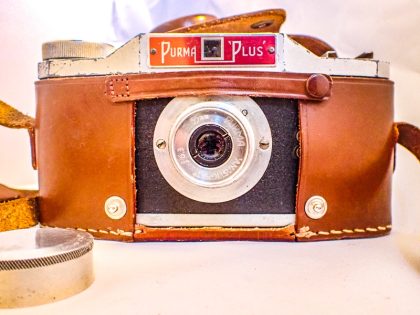
A PurmaTom Purvis, a renowned artist, and Alfred C. Mayo founded Purma Cameras Ltd. in 1935. David Brock of Brock Fireworks gave financial help to launch the company in London. Their office was at Brock House, Langham St, London W1. (Tom Purvis is perhaps better known as a commercial artist who was responsible for many of the great LNER Railway posters of the 1930s.) More Plus camera – no case and no lens cap.
The shutterEither mechanical and/or electronic shutters are possible. Mechanical systems can use a leaf (or iris) shutter or curtain shutter. In digital cameras a third alternative is also possible: the electronic shutter. This works by activating and then deactivating the CCD so that no further light can be recorded, regardless of whether light is hitting the CCD. The shutter controls the exposure time, which can range from thousandths of a second to several minutes or more. Fast shutter speeds freeze action, slow speeds are more suited to stationary subjects. A tripod is recommended for slow exposure shots to avoid camera shake, or IBIS. More fires but the camera has not been tested.
Note: This section is a reproduction of the original guide supplied with the PurmaTom Purvis, a renowned artist, and Alfred C. Mayo founded Purma Cameras Ltd. in 1935. David Brock of Brock Fireworks gave financial help to launch the company in London. Their office was at Brock House, Langham St, London W1. (Tom Purvis is perhaps better known as a commercial artist who was responsible for many of the great LNER Railway posters of the 1930s.) More Plus camera.
The PurmaTom Purvis, a renowned artist, and Alfred C. Mayo founded Purma Cameras Ltd. in 1935. David Brock of Brock Fireworks gave financial help to launch the company in London. Their office was at Brock House, Langham St, London W1. (Tom Purvis is perhaps better known as a commercial artist who was responsible for many of the great LNER Railway posters of the 1930s.) More Plus is a precision-built miniature camera taking 16 pictures 1 ¼ x 1 ¼ in. (3.18 x 3.18 cm.) on standard size V.P. (27 or 127) films.
BODY: The body consists entirely of metal. From left to right along the top (looking at the back of the camera) are : the shoe that holds the Flash Unit, the Cable Release Socket, the Release Button, the Viewfinder and the Film Wind Knob. On the right of the lens (looking at the front of the camera) are the Flash Sockets.
DETACHABLE BACK: The back removes for loading and is held in position by the tripodStand to which the camera can be attached hold it steady, especially during slow exposure shots where camera shake must be avoided. Most tripods have three legs while professionals prefer the more compact but less stable one-legged (mono) versions. More bush in the bottom of the camera. The bush can be unscrewed with the edge of any coin.
LENS: The anastigmatAn anastigmat lens is one in which all optical defects, including astigmatism, have been corrected in the design. The first of this kind, the Protar lens, designed by Paul Rudolph, was introduced by Zeiss in 1889. All modern lenses are anastigmats, so the definition for modern cameras and lenses has become redundant. More lens has a fixed apertureThe aperture is basically a hole in the camera’s lens that lets light pass through it to the shutter and ultimately the film or censor. The aperture not only influences picture brightness but also regulates depth of focus. Most cameras are equipped with an iris aperture that can be freely adjusted or set according to pre-selected values. More of f/6.3 and is ‘ bloomed ‘ to give brilliant negatives which may be enlarged to any size. When not in use it telescopes into the body, and is secured by the screw-on lens cap. The lens gives a sharp picture of all objects from 12 ft. to Infinity without focussing.
FOCAL PLANE SHUTTERShutter comprising one or more roller blinds of fabric or metal, having a variable slit which moves across the back of the camera when the release is pressed and exposes the film progressively. This type of shutter is mounted as close as possible to the surface of the film—i.e., to the focal plane. In that position it is most efficient and also gives consistent exposures with lenses of varying focal lengths. William England invented the focal plane shutter in 1861, re-introduced by B. J. Edwards, 1879, and included in the camera patented by Ottomar Anschutz in 1888, to whom its invention is usually erroneously attributed. More: The special all-metal focal plane shutterShutter comprising one or more roller blinds of fabric or metal, having a variable slit which moves across the back of the camera when the release is pressed and exposes the film progressively. This type of shutter is mounted as close as possible to the surface of the film—i.e., to the focal plane. In that position it is most efficient and also gives consistent exposures with lenses of varying focal lengths. William England invented the focal plane shutter in 1861, re-introduced by B. J. Edwards, 1879, and included in the camera patented by Ottomar Anschutz in 1888, to whom its invention is usually erroneously attributed. More gives three ‘ Instantaneous ‘ speeds and ‘ Time.’ When the camera is held on its left side, the shutter speedThe time a camera sensor or film is exposed to light when taking a photo. More is 1 /500th second; when held level, 1/150th second, and on the right side, l/25th second.
The shutterEither mechanical and/or electronic shutters are possible. Mechanical systems can use a leaf (or iris) shutter or curtain shutter. In digital cameras a third alternative is also possible: the electronic shutter. This works by activating and then deactivating the CCD so that no further light can be recorded, regardless of whether light is hitting the CCD. The shutter controls the exposure time, which can range from thousandths of a second to several minutes or more. Fast shutter speeds freeze action, slow speeds are more suited to stationary subjects. A tripod is recommended for slow exposure shots to avoid camera shake, or IBIS. More is set by the act of advancing the film, and released by a press button on the top of the camera. After release it can only be re-set by winding the film on to the next frame, making double exposures impossible.
VIEWFINDER : The viewfinder is of the optical direct-vision type, sighted through the window in the back of the body. The three Instantaneous shutterEither mechanical and/or electronic shutters are possible. Mechanical systems can use a leaf (or iris) shutter or curtain shutter. In digital cameras a third alternative is also possible: the electronic shutter. This works by activating and then deactivating the CCD so that no further light can be recorded, regardless of whether light is hitting the CCD. The shutter controls the exposure time, which can range from thousandths of a second to several minutes or more. Fast shutter speeds freeze action, slow speeds are more suited to stationary subjects. A tripod is recommended for slow exposure shots to avoid camera shake, or IBIS. More speeds are marked around the viewfinder window to show how to hold the camera for the various speeds.
A blind covers the viewfinder until the film is wound on and the shutterEither mechanical and/or electronic shutters are possible. Mechanical systems can use a leaf (or iris) shutter or curtain shutter. In digital cameras a third alternative is also possible: the electronic shutter. This works by activating and then deactivating the CCD so that no further light can be recorded, regardless of whether light is hitting the CCD. The shutter controls the exposure time, which can range from thousandths of a second to several minutes or more. Fast shutter speeds freeze action, slow speeds are more suited to stationary subjects. A tripod is recommended for slow exposure shots to avoid camera shake, or IBIS. More set for making an exposureThe amount of light that reaches the film (or camera sensor). It determines how light or dark an image is. The exposure of an image is determined by the aperture, shutter speed, and film speed (ISO). During exposure, the sensors or chemicals on the film in analogue models, are subjected to the light outside the camera for a certain time. More.
FILM TRANSPORT: The film winding knob is on the right of the camera. Turning the knob winds the film, sets the shutterEither mechanical and/or electronic shutters are possible. Mechanical systems can use a leaf (or iris) shutter or curtain shutter. In digital cameras a third alternative is also possible: the electronic shutter. This works by activating and then deactivating the CCD so that no further light can be recorded, regardless of whether light is hitting the CCD. The shutter controls the exposure time, which can range from thousandths of a second to several minutes or more. Fast shutter speeds freeze action, slow speeds are more suited to stationary subjects. A tripod is recommended for slow exposure shots to avoid camera shake, or IBIS. More, and raises the blind in the viewfinder, indicating that the camera is ready for use.