Douglas Levere began rephotographing Berenice Abbott’s Changing New York in 1997, returning to her original locations with a large format camera at the same time of day and season. The project had an almost accidental origin: Levere was at an auction preview when he stopped in front of Abbott’s vintage contact print of Broadway near Broome Street, photographed in 1935. He lived on Broome Street. Standing in front of an image of the view outside his own building, taken six decades earlier, he found himself compulsively comparing and contrasting — and before long, imagining what his own camera would see from the same spot.
What followed was a painstaking effort to recreate not just the locations but the conditions of the original photographs. Levere sourced a camera of the same type Abbott had used, and worked to match the time of year and time of day as precisely as possible. Her photographs were dated, which solved the seasonal question, but finding the exact position, angle, and light proved considerably harder. On one occasion, needing to photograph Fifth Avenue shoppers from a double-decker bus, and unable to get permission from the city to stop in traffic, Levere had the bus driver feign an emergency — placing orange cones on the road and opening the engine hood — in order to hold position long enough to make the exposureThe amount of light that reaches the film (or camera sensor). It determines how light or dark an image is. The exposure of an image is determined by the aperture, shutter speed, and film speed (ISO). During exposure, the sensors or chemicals on the film in analogue models, are subjected to the light outside the camera for a certain time. More at precisely 1:10 PM.
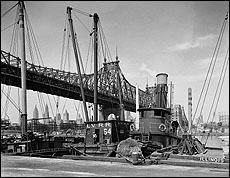
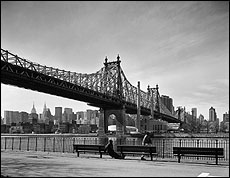
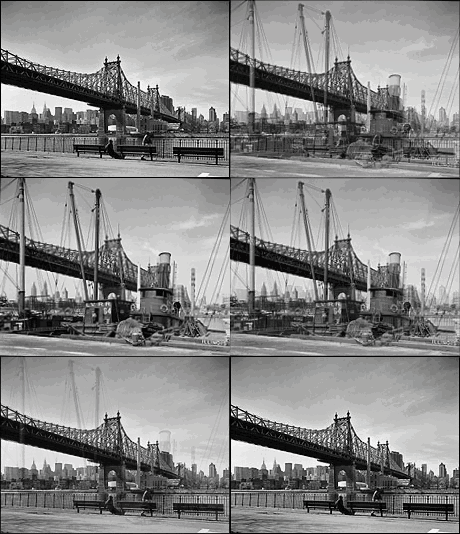
The resulting book, New York Changing, was published by Princeton Architectural Press in 2004 and drew wide critical attention. Columbia University photographer and educator Thomas Roma wrote that the project would seem bound to collapse under the weight of Abbott’s formidable legacy — and that the photographs prove otherwise in every way. The project remains one of the most technically rigorous and culturally resonant examples of rephotographyRephotography — sometimes called repeat photography — is the practice of photographing the same location from the same position on two or more separate occasions, with a significant time gap between images. The objective is a direct visual comparison: a diachronic pair that shows what has changed, what has survived, and what has been lost entirely. Read the Post - The Art and Craft of Photographing Time. Rephotography Organisations and Information More ever produced — a reminder that the discipline, done properly, is as much an act of historical research as it is of photography.
[azp_custom_product id=”27″]